All in with GC: A full mouth restoration from A to Z
Publicado en:GC Get Connected
All in with GC: A full mouth restoration from A to Z
Being able to easily rely on your trusted brands has
many benefits to keep your laboratory running smoothly.
This implies knowing the products and experiencing
their worth during the actual labour. Our biggest
challenge is to rehabilitate a full mouth and restore lost
functions, provide comfort while offering a natural
aesthetic appearance that is personalised for each type
of patient (shape, size, age, etc.).
The entire range from GC, from the
provisionals to the final ceramic
restoration, perfectly complement
each other. It takes off unnecessary
steps from the equation to simplify
our regimen, because I can use the
same way of working throughout the
entire range. This way, it is easy to
specifically cater to the benefits you’re
looking for, depending on the case.
From the provisional restorations,
characterised with OPTIGLAZE color, to
the selection of Initial LiSi Blocks with
their natural opalescence and finally,
the complete Initial IQ ONE SQIN
system (Lustre Pastes, Spectrum Stains
and SQIN ceramics): The following case
evidences the high potential of the
synergies, resulting in a satisfying result
in the most efficient way.
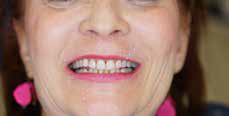
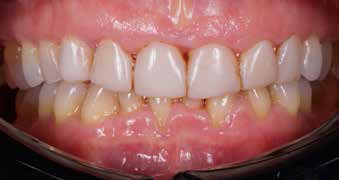
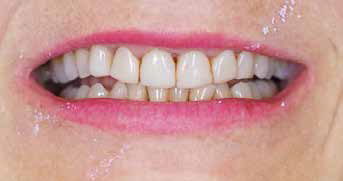
A 52-year-old woman came to the
office of Dr Tomasella, expressing her
concerns about the aesthetics of her
teeth and her desire for a radical
change in the shortest time possible,
without undergoing orthodontics. Her
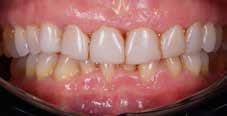
teeth were restored with composite
restorations of inadequate aesthetic
level and were disproportional in size.
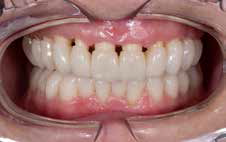
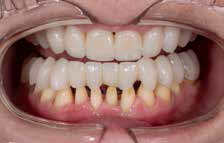
The smile arc was irregular (Figs. 1,2).
Fig. 1
Fig. 2
Figs. 1 and 2: Initial situation
Temporary full-arch PMMA
restorations
Individual lithium disilicate
ceramic crowns
The dentist prepared the teeth from
16 to 26 and from 36 to 46 for future
individual crowns.
After having received all collected
information, the provisional
restorations were made in the form
of two bridges; restorations were
joined to facilitate the placement
and retention in the clinic. The
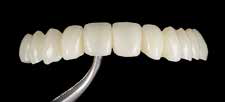
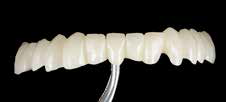
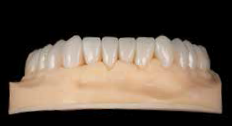
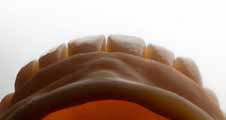
bridges were made of PMMA (Figs. 3,
4) and were characterized with
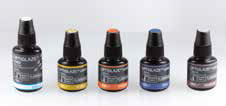
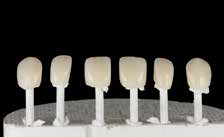
OPTIGLAZE color (Fig. 5).
The OPTIGLAZE was applied to all
teeth: B Plus was applied to the
cervical and middle area, Lavender
and Blue in the incisal zone and
Orange in the interproximal zone.
Especially in this type of complex
cases, these temporary restorations
are important to see and evaluate
study shapes, sizes, proportions,
occlusion, functionality and
aesthetics (Figs. 6-8).
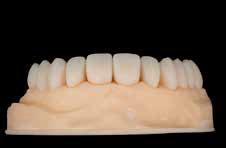
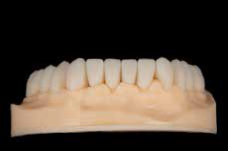
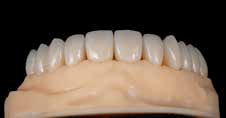
Once the aesthetics, shape, proportions and occlusion were verified and adjusted, the restorations were milled from 24 blocks of Initial LiSi Block, shade A1 LT (Figs 9,10). From 14 to 24 and 34 to 44, a small vestibular reduction of 0.2-0.3 mm was made; the more posterior crowns were left fully monolithically. The shade A1 LT (low translucency) was chosen because all restorations were full crowns; a high translucency could lead to loss of value in this case, resulting in a more greyish appearance of the crowns.
Fig. 3
Fig. 4
Fig.5
Fig. 6
Fig. 7
Fig. 8
Figs. 3 and 4: Full arch, temporary PMMA restorations.
Figs. 5: OPTIGLAZE color (GC)
Figs. 6: Full arch, temporary PMMA restorations
Figs. 7: Full arch, temporary PMMA restorations.
Figs. 8: The temporary restorations, characterized with OPTIGLAZE color (GC), in the mouth.
Fig. 9
Fig. 10
Figs. 9 and 10: The crowns, milled from
lithium disilicate CAD/CAM blocks (Initial LiSi
Block, GC), before characterization.
SUPER TIP: For thin veneers of 0.1-0.3 mm, we
can use HT (high translucency; given that the
substrate is favourable) and very aesthetic
results can be obtained by simple painting,
but in case the total restoration thickness of
the veneer exceeds 0.6mm and it is covered
with enamel, the value will drop and it will
look gray in the mouth if the underlying
ceramic is too translucent.
Being a complete rehabilitation and favourable substrate, a cut-back and microlayering was chosen, which gives natural aesthetics thanks to the combination of the Initial IQ Lustre Pastes ONE, Initial Spectrum Stains and Initial IQ SQIN ceramics – the ‘ONE SQIN’ concept (GC). For the application of the Lustre Pastes and Spectrum Stains, the teeth were devided into 3 basic zones: a cervical, middle and incisal zone.
Before starting with the characterization, all crowns were covered with a thin layer of L-NFL (Neutral Fluorescent). Then, a mixture of L-B + L-NFL was applied to the central and lateral incisors to create a subtle chromatic effect throughout the cervical area. On the canines, pure L-B was applied, to give them a bit more chroma than the incisors, like in natural teeth. In the middle area, it is interesting to create a light refraction effect. Therefore, a mixture of L-V (Value) and L-1 (Enamel Effect 1: Vanilla) was applied on the incisors, creating a “belt” between the cervical and incisal areas.
Finally, in the incisal area we create a “translucent zone” (light absorption edge) L-3 (Enamel Effect 3: Light Grey) + L-6 (Enamel Effect 6: Dark Blue) + SPS-18 (Illusion 1) + L-10 (Enamel Effect 10: Twilight) and the mamelons a mixture of L-V + L-1 + L-B + SPS-4 (Light Terracotta). After the firing with Initial Lustre Pastes ONE (Fig. 11), the anterior teeth (up to the second premolar) were slightly sandblasted at very low pressure (0.8-1 bar) at a distance of 10 cm to remove the gloss and to create micromechanical retention for the subsequent layer of SQIN ceramics. In the cervical zone, Body-B + Enamel E-58 were applied; Translucent TO (Opal Booster) was applied on the mesial and distal edges. GUM Neutral (colourless and absent of additional fluorescence) and Enamel E-58 were applied in the incisal area between those edges, blending the bands.
The morphology was created in the wet stage; the “Form & Texture Liquid” gives the ceramic the plasticity to easily model it with a brush. The restorations were finished with Panther rubber polishers (Sirius Ceramics).
Fig. 11
Figs. 11: Crowns after application and firing
of Initial IQ Lustre Pastes ONE and Initial
Spectrum Stains (GC). This first firing,
fluorescence and colour are added and also
serves as the connection firing.
SUPER TIP: Initial LiSi Block exhibits natural
opalescence; therefore, the halo effect can be
created by wearing the structure at 45°. In
case the halo needs to be enhanced a little
more, pure SPS-4 (Light Terracotta).
Figs. 12 and 13: Crowns after application and firing of with Initial IQ SQIN ceramics (GC) SUPER TIP: To avoid loss of value, it is important to control the enamel thickness and not exceed it. By respecting the vestibular reduction of the CAD design, it is avoided that the restoration will have a grayish aspect.
Fig . 12
Fig. 13
Fig. 14
Figs. 14: The final surface with a microtexture
that is suitable for this patient.
CONCLUSIONS
The most important factors are stability, control, reproducibility, time and aesthetics:
Stability of the material means that shrinkage of the material is practically nil. The crown can be finished in a single ceramic application.
Visual control is present at the same time as we apply the different effects: “what you see is what you get”
Reproducible because a “step by step” work protocol can be established where the margin of error is exponentially reduced.
Time is drastically reduced by using this technique and protocol.
Fig. 15
Fig. 16
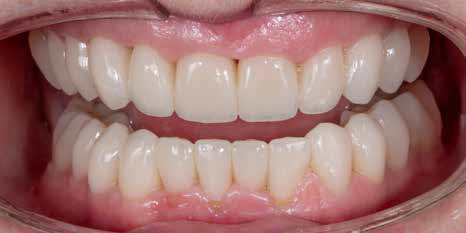
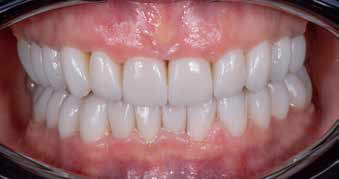
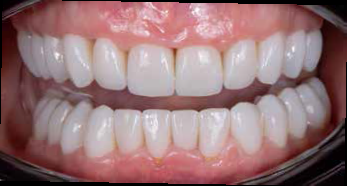
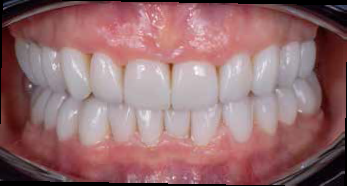
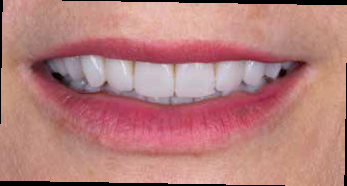
Figs. 15 and 16: The final result in the mouth. & Figs. 17: Comparison of the situation before (left) and after treatment (right).
Aesthetics is what all dental technicians are looking for, and nature is approached thanks to the opalescent effect of Initial LiSi Block, the 3D effect of the Initial IQ Lustre Pastes ONE combined with Initial Spectrum Stains and the ceramic coverage of Initial IQ SQIN.
This case demonstrates how easy it can be to restore a full arch with the right materials and the right protocol. The result is a fully functional and aesthetic work with a natural appearance. The patient was very happy with the result and excited to see herself for the first time. The responsibility we have as dental technicians is very high. It is not only about aesthetics, but also about a patient’s health and wellbeing.