From conception to implementation: Efficient production of a hybrid implant-supported full-arch restoration
Publicado en:GC Get Connected
From conception to implementation: Efficient production of a hybrid implant-supported full-arch restoration
A metal-acrylic hybrid prosthesis has been a traditional
choice for implant-supported full-arch restorations.
A newer development has centred around the use of
zirconia. While acrylics are lighter and cheaper, zirconia
offers the greatest combination of strength and aesthetics.
This article describes a protocol for the fabrication of
hybrid prostheses consisting of a primary structure
made of titanium and a secondary structure made of
zirconia.
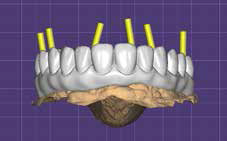
The tooth and gum morphology were
digitally designed in DentalCAD
(exocad, Germany) (Figure 1). Next, a
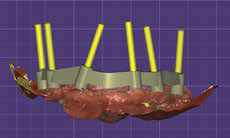
passive bar was designed in a new
project (Figure 2), manufactured in
aluminium and sent to the clinic for
testing and adjustment.
Unlike teeth, that are connected to the
bone via the periodontal ligament,
implants have a rigid connection to
the bone. Therefore, a passive fit of the
suprastructure is very important.
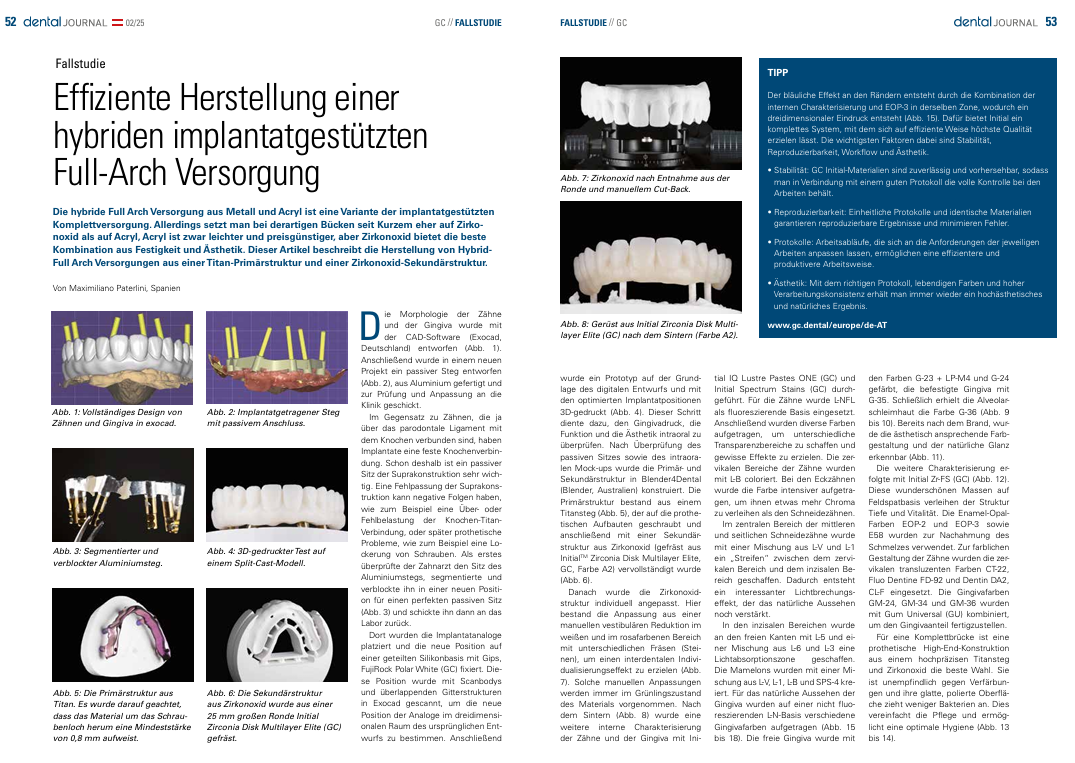
Fig. 1: Complete teeth and gum design in exocad.
Fig. 2: Bar on implants with passive connection.
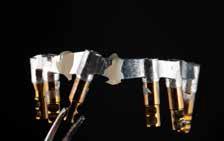
Fig. 3: Cut and splinted aluminium bar.
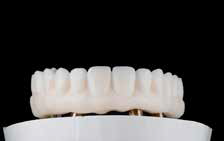
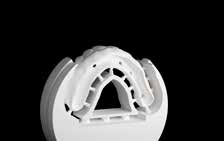
Fig. 4: Printed test on model created with split cast.
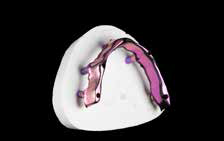
Fig. 5: The primary structure in titanium. Care
was taken that around the screw hole, the
material had a minimum thickness of 0.8 mm.
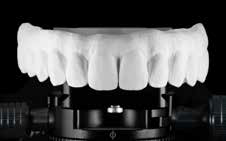
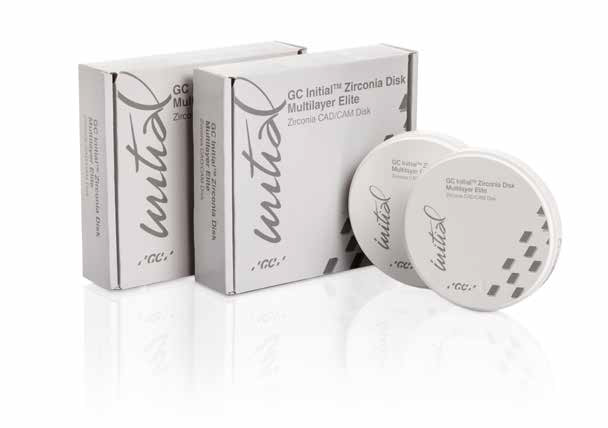
Fig. 6: The secondary zirconia structure was milled from a 25 mm Initial Zirconia Disk Multilayer Elite.
A misfit of the suprastructure can have negative effects, such as detrimental stresses on the bone- titanium junction or prosthetic problems, such as screw loosening. The dentist verified the seating of the aluminium bar, cut and splinted it in the new position for a perfect passive fit (Figure 3) and sent it back to the lab. Then, the analogues were placed and the new position was fixed using a silicone base former and FujiRock Polar White gypsum. This was scanned with scanbodies and overlap meshes in exocad to have the new position of the analogues located in the three-dimensional space of the original design.
A prototype based on the digital design and with the optimised implant positions was then 3D-printed (Figure 4). This step served to verify the gum pressure, function, and aesthetics intraorally. After verification of the passive structure and intraoral mock-up, the primary and secondary structure were designed in Blender4Dental (Blender). The primary structure consists of a titanium bar (Figure 5) that needs to be screwed onto the prosthetic abutments and is then completed with a secondary zirconia structure. This secondary structure was milled from Initial Zirconia Disk Multilayer Elite from GC, Shade A2 (Figure 6).
Next, the zirconia structure was
customised. In this case, a manual
vestibular reduction was carried out
in both the white and pink parts using
different burs and stones to achieve
an individualisation effect between
the teeth (Figure 7). Such manual
changes are always done in the green
state of the material.
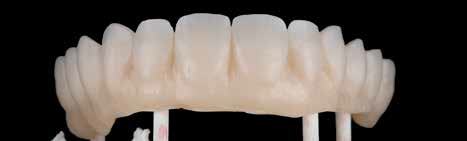
After sintering (Figure 8), further
internal characterisation of the gum
and teeth was done with Initial IQ
Lustre Pastes ONE (GC) and Initial
Spectrum Stains (GC). For the teeth,
L-NFL was used as a fluorescent base.
Different colours were then applied on top to create different chromatic
areas and effects. The cervical areas of
the teeth were coloured with L-B.
Fig. 7: Zirconia framework after removal from the disk and manual cut-back.
Fig. 8: Initial Zirconia Disk Multilayer Elite framework after sintering (Shade A2).
In the middle area of the central and lateral incisors, a light refracting zone between the cervical area and the incisal area was created with a mixture of L-V and L-1. This effect adds to the natural appearance. In the incisal area, a light absorption zone was created at the free edge with L-5 and a mixture of L-6 and L-3.
The mamelons were created with a
mixture of L-V, L-1, L-B and SPS-4.
Finally, a non-fluorescent L-N base
was used for the gingiva, and different
gum shades were added to create
naturalness.
Figs. 9-10: Application of Initial IQ Lustre Pastes ONE with Initial Spectrum Stains (GC).
Fig. 11: Initial IQ Lustre Pastes ONE with Initial Spectrum Stains: result after firing.
Fig. 12: Application of different masses of Initial Zr-FS: EOP-2, EOP-3, E-58, CT-22, FD-92, Dentin A2, CL-F; GM-24, GM-34, GM-36 and GU.
The free gingiva was coloured with G-23+ LP-M4 and G-24, while G-35 was used for the attached gingiva. The alveolar mucosa was coloured last with G-36 (Figures 9-10).
After firing, we already see the beautiful, natural colour and gloss appearing (Figure 11). Further characterisation was done with Initial Zr-FS (Figure 12). These beautiful feldspar-based masses add depth and vitality to the structure. Enamel Opal shades EOP-2 and EOP-3 and E58 were used to mimic the enamel.
Cervical translucent shade CT-22, Fluo Dentin FD-92, Dentin DA2, CL-F were used for the teeth. Gum shades GM-24, GM-34 and GM-36 were combined with gum universal (GU) to finish the gingiva.
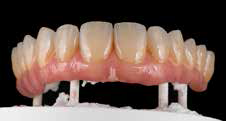
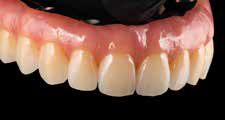
Figs. 13-14: Result after glazing.
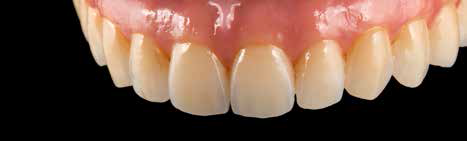
Fig. 15: The bluish 3D-effect on the incisal edge adds to the vividness of the teeth.
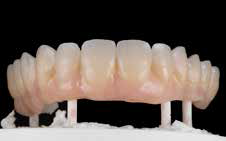
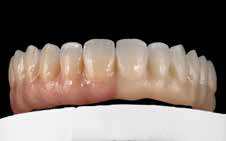
A high-end prosthesis, comprising a high-precision titanium bar and zirconia stands out as the premium choice for a full-arch prosthesis. It is resistant to staining and its smooth, polished surface is less likely to attract bacteria, resulting in easy maintenance and optimal hygiene. (Figures 13-14)
TIP: the blue effect on the edges comes from the combination of the internal characterisation and putting EOP-3 in the same zone, creating that three-dimensional area (Figure 15).
Initial offers a complete system to achieve the highest quality in the most efficient way. The most notable factors are: stability, reproducibility, time and aesthetics.
01. Stability: The Initial materials act reliable and predictable; combined with a good protocol, this gives great control over your work.
02. Reproducibility: That same protocol and materials give reproducible results, minimizing possible errors.
03. Time: Workflows that can be customised to fit the need of each work enable to be more efficient and productive.
04. Aesthetics: Due to the right protocol, the vibrant shades and the consistency in results, a very aesthetic and natural-looking outcome can be achieved, time after time.
CONCLUSION
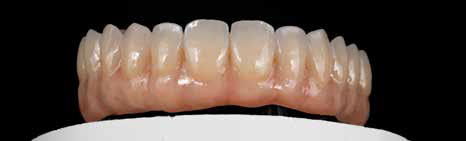
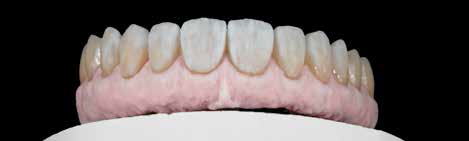
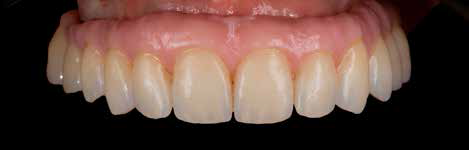
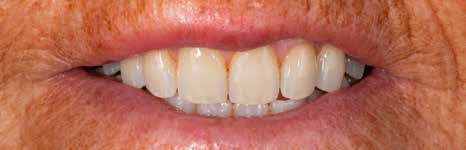
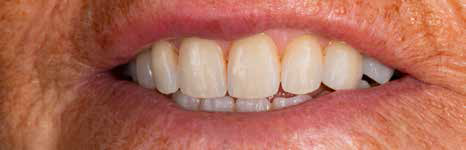
Considering all these advantages, it stands out as an exceptional choice for delivering durable and satisfying dental solutions (Figures 16-18). By prioritising quality and precision, we can ensure our work leaves a lasting impact on both patients and practitioners alike.